
AI-Native Change Agent
November 10, 2025
The AI-Native Change Agent Function
# Article
The future of work isn't just about AI. It's about the people who help organizations navigate the transition

Rashid Smith
Here's a problem most organizations don't realize they have: they're hiring AI engineers to build the technology, training employees to use the tools, and expecting transformation to just... happen.
It doesn't.
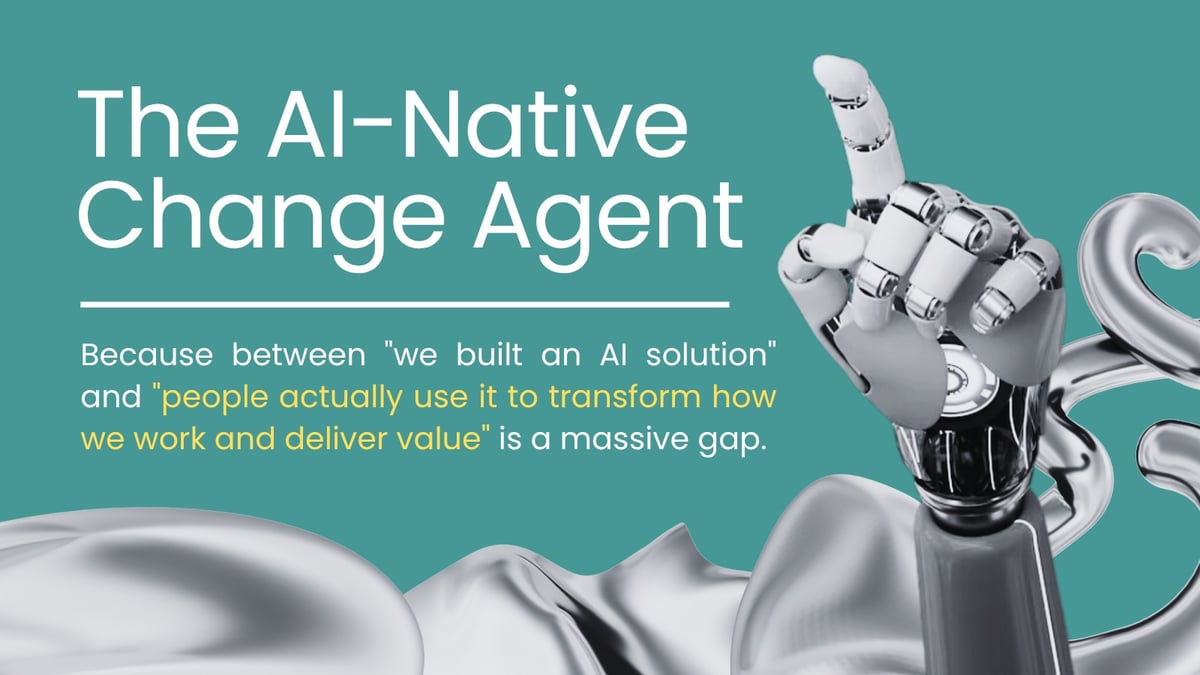
Because between "we built an AI solution" and "people actually use it to transform how we work" is a massive gap. That gap is filled with confusion, resistance, misaligned expectations, and abandoned pilots.
Who bridges that gap?
Engineers focus on the technology. Executives focus on strategy. End users focus on getting their work done. The missing function that connects these groups is the AI-Native Change Agent.
This isn't a job title. It is a function. And if your organization is serious about AI transformation, someone needs to be doing it, whether it is formalized or not. Critically, this function helps guide the development of AI solutions so they actually make it to production and deliver business value, not just proofs of concept.
What Is an AI-Native Change Agent?
An AI-Native Change Agent is the person or team responsible for ensuring that AI solutions do not just get built, they get adopted, integrated, and used to drive real business outcomes. They translate across domains, align incentives, and steward initiatives so ideas move from spark to production and realize value as quickly as possible.
They sit at the intersection of three worlds:
World: Technology (Engineers, Data Scientists)
What they care about: Building AI solutions that work
What they need from the Change Agent: Clear requirements, realistic expectations, feedback loops
World: Business (Executives, Product Owners)
What they care about: Delivering measurable ROI
What they need from the Change Agent: Proof of value, risk mitigation, strategic alignment
World: People (End Users, Teams)
What they care about: Doing their jobs better, not harder
What they need from the Change Agent: Training, support, trust, psychological safety
The Change Agent's Goal: Translate between these worlds, align their goals, and orchestrate the messy, human process of transformation.
Why This Function Is Critical (And Why It Is Often Missing)
Most organizations approach AI transformation like a technology project.
They focus on: Hiring AI talent, Building models, and Deploying tools.
Then they are shocked when adoption is low, ROI is unclear, and people resist.
Here is what they are missing: AI transformation is a people and operating model problem disguised as a technology problem.
The technology is the easy part. The hard part is:
- Getting people to trust AI
- Helping them unlearn old habits
- Redesigning workflows around new capabilities
- Managing the fear, uncertainty, and resistance that comes with change
This is change leadership in the Age of AI. It requires someone who understands both the technology and the human side of transformation, and who can embed AI into everyday work rather than bolt it on after the fact. That is the AI-Native Change Agent.
The AI-Native Change Agent’s Approach to AI Success
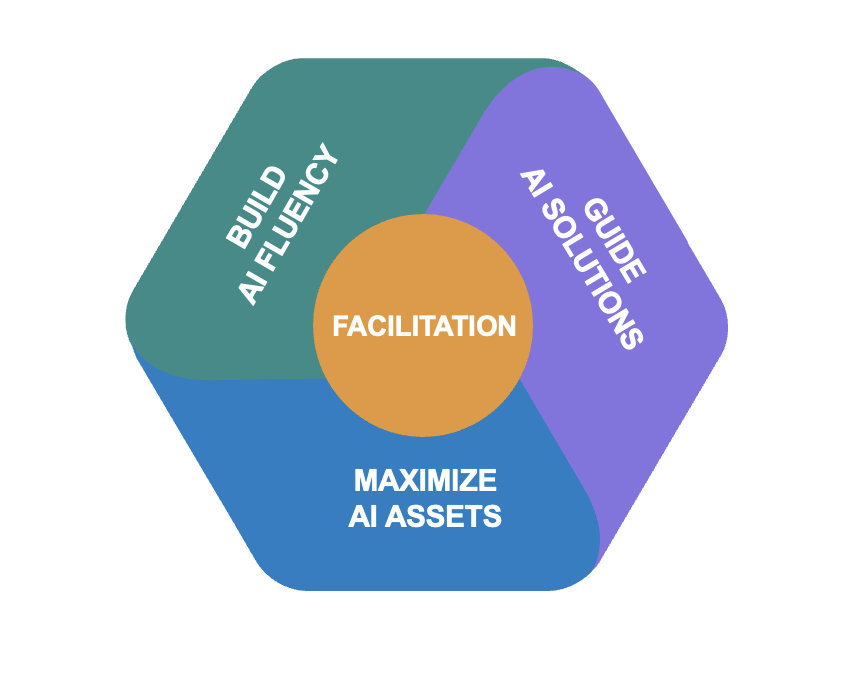
Facilitation is the core skill. Around it, the approach has three parts:
- Build Your AI Fluency: Understand how LLMs work at a high level, and common AI risks and limitations. Learn the nuance between traditional software solutions and AI solutions.
- Maximize the Value of Your AI Assets: Leverage the assets you already own and leverage their hidden AI features and capabilities.
- Guide AI Solutions: Drive AI solutions from concept to production and ensure solutions move beyond the POC graveyard.
Build Your AI Fluency
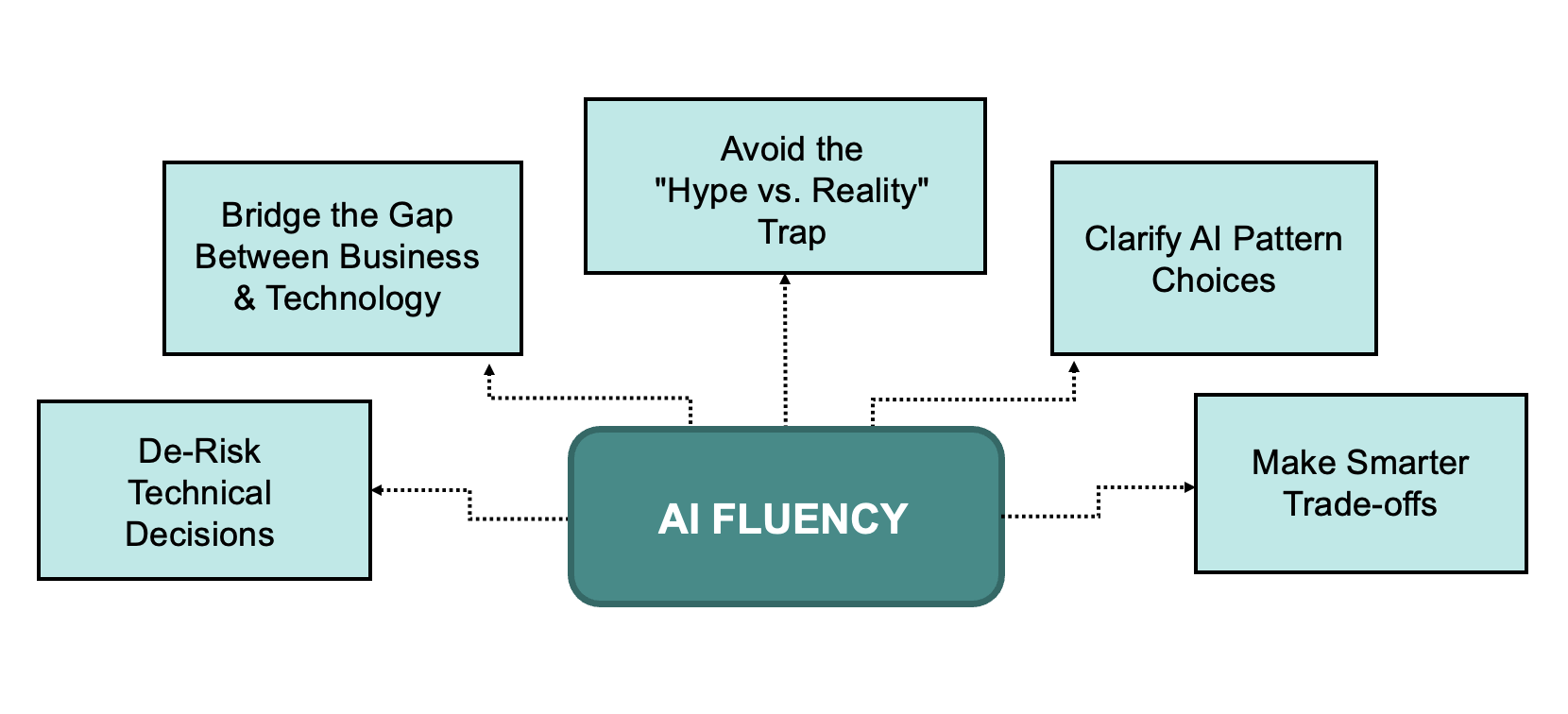
You do not need to be an AI engineer, but you do need to understand how LLMs work at a high level, and common AI risks and limitations. Connect technical capabilities to clear business goals, and put the AI-Native success factors into practice so teams can make informed choices. The AI-Native foundations Training course provides the foundational fluency and shared language to do this well.
Maximize the Value of Your AI Assets
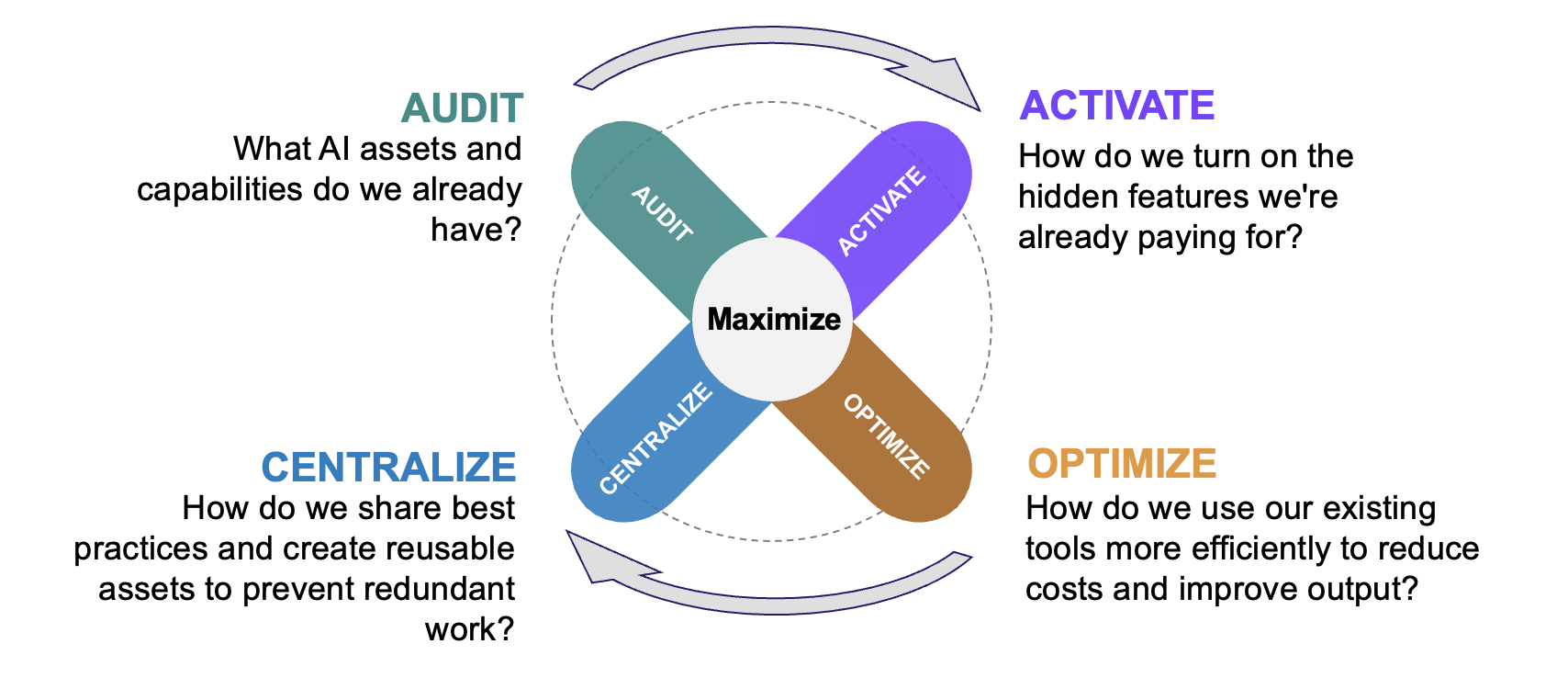
Master the assets you already own. Leverage hidden AI features and capabilities that are often underused. Define clear, measurable goals before starting an AI project, set up dashboards to track adoption, usage, and outcomes, and run retrospectives to identify what is working and what is not. Use time saved, satisfaction, and error-rate data to make the case for scaling successful initiatives. Document and share wins so the organization sees the return on assets it already has.
Guide AI Solutions (The AI-Native Solution Lifecycle)
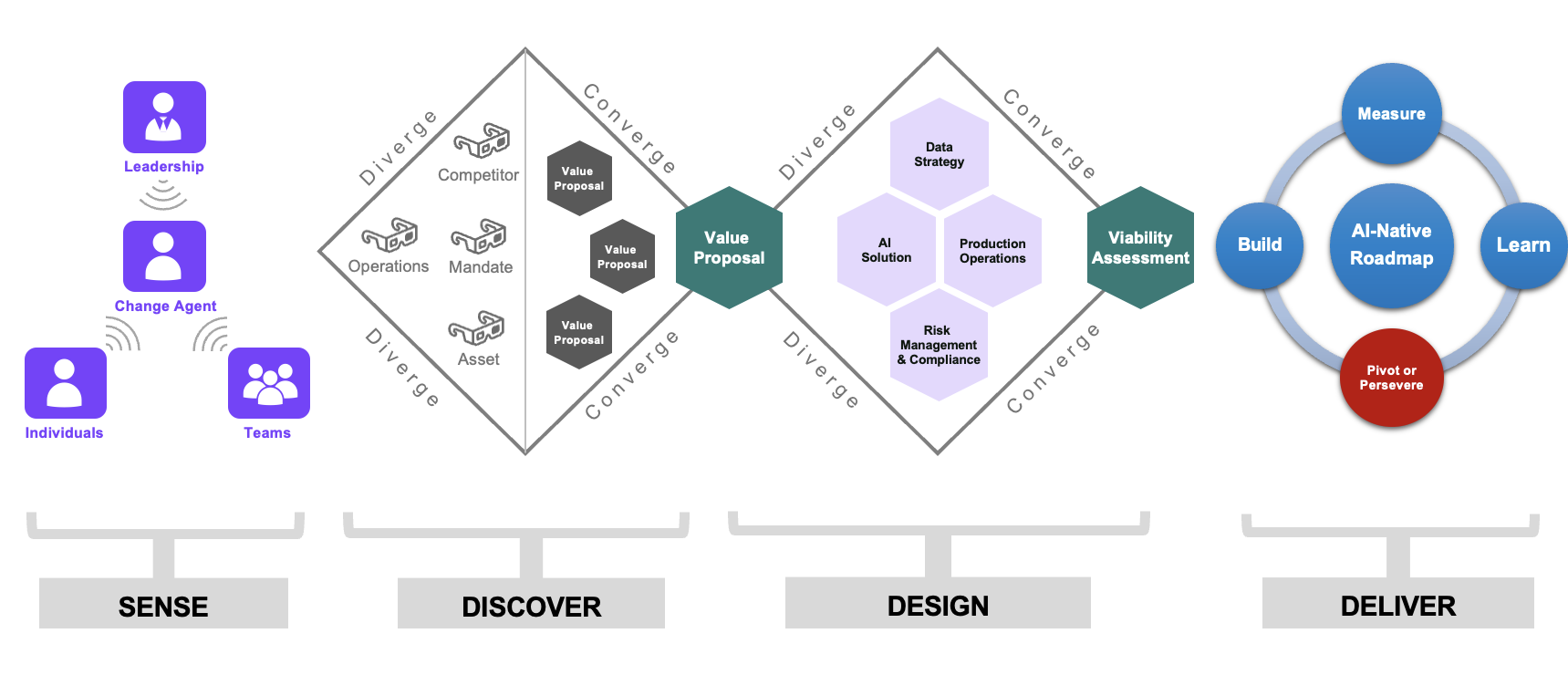
To avoid the POC graveyard for complex problems, Change Agents use a guided, four-phase process to take solutions from idea to production.
For bigger, more complex challenges, just maximizing existing tools is not enough. You need a structured approach to guide an idea from a spark to a scalable solution. This is the core framework that helps teams build AI solutions that actually go to production and realize value as quickly as possible.
SENSE: Listen for signals across leadership, individuals, and teams. Surface opportunities from operations, mandates, assets, and competitive pressures. Clarify where value could be created and capture early value proposals.
DISCOVER: Engage stakeholders to uncover the true nature of the problem and refine the value proposal. Converge on a clear problem framing, and desired user and business outcomes.
DESIGN: Create a holistic solution, not just a model. Align the AI solution with data strategy, production operations, and risk management and compliance. Plan for how the work will run in production, how the model will be monitored, and how safeguards will operate.
DELIVER: Execute a resilient AI-Native roadmap. Build, measure, and learn in short cycles, decide when to pivot or persevere, and scale only after value is demonstrated. Measure adoption, usage, and outcomes so the solution earns its way into production and stays valuable.
In practice, Change Agents facilitate each phase, coordinate handoffs, and keep teams moving through the cycle with evidence, not assumptions.
The Five Core Responsibilities of an AI-Native Change Agent
Facilitation: Guiding Teams Through AI Adoption
Change Agents do not just announce new AI tools and hope people use them. They actively facilitate the adoption process.
What this looks like:
- Running workshops to help teams identify AI opportunities in their workflows
- Facilitating discussions about fears, concerns, and resistance
- Creating safe spaces for experimentation and failure
- Guiding teams through the messy process of redesigning work around AI
- Connecting facilitation activities to lifecycle checkpoints, from sensing signals to preparing for delivery to production
Example scenario: A sales team gets access to an AI tool that drafts personalized outreach emails. Instead of just sending a "here's the new tool" email, the Change Agent:
- Runs a hands-on workshop where the team tries the tool together
- Facilitates a discussion about what works, what does not, and what they are worried about
- Helps them redesign their outreach process to incorporate AI without losing the personal touch
- Checks in weekly to troubleshoot issues and celebrate wins
Key skill: The ability to hold space for difficult conversations and guide groups toward productive outcomes.
Translation: Bridging the Gap Between Technical and Non-Technical Stakeholders
Engineers speak in models, APIs, and accuracy metrics. Business leaders speak in ROI, risk, and strategy. End users speak in "will this make my job easier or harder?"
The Change Agent translates between these languages.
What this looks like:
- Explaining technical concepts such as hallucinations or context windows to non-technical stakeholders in plain language
- Translating business requirements into clear, actionable specs for engineers
- Helping end users articulate their needs in ways that engineers can act on
- Turning discovery insights into a crisp value proposal and design constraints that support production viability
Example scenario: An executive asks, "Why can't the AI just read all our customer feedback and tell us what to build next?"
The Change Agent translates:
To the executive: "AI can identify patterns in feedback, but it cannot make strategic product decisions. It can surface insights, but you still need to prioritize based on your business goals."
To the engineer: "The exec wants a system that analyzes customer feedback and surfaces the most common pain points, ranked by frequency and severity. Can we build that?"
Key skill: The ability to code-switch between technical and business contexts fluently.
Risk Management: Identifying and Mitigating AI-Specific Risks
AI introduces new risks that most organizations are not equipped to handle:
- Data privacy violations, for example pasting sensitive data into a public tool
- Bias and fairness issues
- Over-reliance on AI for high-stakes decisions
- Hallucinations and inaccuracies
- Security vulnerabilities
The Change Agent does not just identify these risks, they build systems to mitigate them.
What this looks like:
- Supporting the creation of AI usage policies and guidelines
- Running risk assessments for new AI projects
- Training teams to recognize and avoid common pitfalls
- Ensuring the DESIGN phase includes necessary stakeholders for risk and compliance so solutions are safe to take to production
Example scenario: A marketing team wants to use AI to generate social media content.
The Change Agent:
- Identifies the risk: AI might generate off-brand or offensive content
- Mitigates it: Implements a human in the loop review before anything goes live
- Trains the team: Runs a workshop on how to spot problematic AI outputs
Key skill: The ability to think critically about what could go wrong and design safeguards without killing innovation.
Stakeholder Management: Aligning Diverse Groups Around AI Initiatives
AI projects involve a lot of stakeholders with different priorities:
- Engineers focus on building effective technology
- Executives prioritize measurable ROI
- End users care about job security and meaningful work
- Legal focuses on compliance and risk
- IT prioritizes security and reliability
The Change Agent aligns these groups around shared goals.
What this looks like:
- Identifying all stakeholders early and understanding their concerns
- Creating forums for cross-functional collaboration
- Negotiating tradeoffs and finding win-win solutions
- Keeping everyone informed and engaged throughout the initiative
- Shaping a realistic AI-Native roadmap so the solution can be delivered to production in phases, with value proven along the way
Example scenario: An AI chatbot project has five stakeholder groups with different concerns:
- Engineering: Aims to use the most suitable LLM for the problem
- Legal: Focused on data privacy
- Customer Support: Focused on service quality and role clarity
- Finance: Looks for cost savings and efficiency
- Executives: Want timely execution with clear outcomes
The Change Agent:
- Runs a kickoff meeting where all groups voice their concerns
- Negotiates a phased rollout, start with low-risk use cases, prove value, then scale
- Sets up regular check-ins to keep everyone aligned
- Celebrates early wins to build momentum
Key skill: The ability to navigate organizational dynamics and build coalitions.
Measurement: Proving Value and Driving Continuous Improvement
If you cannot measure it, you cannot improve it. And if you cannot prove value, you cannot secure buy-in for the next initiative.
The Change Agent defines success metrics, tracks them, and uses data to drive continuous improvement.
What this looks like:
- Defining clear, measurable goals before starting an AI project
- Setting up dashboards to track adoption, usage, and outcomes
- Running retrospectives to identify what is working and what is not
- Using data to make the case for scaling successful initiatives
- Operating the DELIVER loop of build, measure, learn to decide when to pivot or persevere, ensuring the solution earns its way into production and stays valuable
Example scenario: A team deploys an AI tool to automate report generation.
The Change Agent:
- Defines success metrics: time saved per report, user satisfaction, error rate
- Sets up a dashboard to track these metrics weekly
- Runs a retrospective: "We are saving 5 hours per week, but error rate is higher than expected. Let's refine the prompts."
- Uses the time-saved data to make the case for expanding the tool to other teams
Key skill: The ability to define meaningful metrics and use data to tell a compelling story.
The Skills of an Effective AI-Native Change Agent
Technical Literacy
Understanding of how AI works, enough to have credible conversations with engineers and translate meaningful concepts to the business.
Facilitation
Ability to run workshops, manage group dynamics, and guide teams through difficult conversations.
Communication
Translating between technical and non-technical audiences, storytelling, persuasion.
Change Management
Understanding of how people adopt new behaviors, managing resistance, building psychological safety.
Risk Management
Identifying risks, designing mitigation strategies, balancing innovation with safety.
Stakeholder Management
Navigating organizational politics, building coalitions, aligning diverse groups.
Data Literacy
Defining metrics, analyzing data, using data to drive decisions.
Empathy
Understanding people's fears and motivations, and building trust.
Where Does This Function Sit in the Organization?
Anyone can be a change agent but some helpful patterns are:
Model 1: Embedded in the AI/Data Team
Pros: Close to the technology, can influence solution design early
Cons: May be seen as the AI team's person, not a neutral facilitator
Model 2: Part of an Organizational Development or Change Management Team
Pros: Expertise in change management, seen as neutral
Cons: May lack technical credibility
Model 3: Embedded in Business Units
Pros: Deep understanding of business context, close to end users
Cons: May lack visibility into other AI initiatives across the organization
Model 4: A Dedicated AI Transformation Office
Pros: Central coordination, cross-functional visibility
Cons: Can become bureaucratic, may slow down innovation
How to Get Started
Step 1: Take the AI-Native Change Agent course -> https://scaledagile.com/certification/ai-native-change-agent/
Step 2: Build your technical literacy
Understand how LLMs work at a high level, common AI risks and limitations, and the basics of prompt engineering.
Step 3: Maximize your existing value
Master the assets you already own and leverage their hidden AI features and capabilities. Measure adoption, outcomes, and time saved to surface quick wins.
Step 4: Identify a pilot initiative
Pick one AI project where you can add value. It should be important enough to matter, small enough to manage, and involve multiple stakeholders.
Step 5: Offer to facilitate
Volunteer to run workshops, coordinate stakeholders, or manage adoption.
Step 7: Document and share wins
Track what is working. Share success stories. Build the case for formalizing the function.
Step 8: Build a network
Connect with others doing similar work. Share learnings. Build a community of practice.
The Bottom Line
AI transformation is not just about building better models or deploying more tools. It is about helping people navigate the messy, uncertain, human process of changing how they work.
That requires someone who can facilitate, translate, manage risk, align stakeholders, and prove value.
That someone is the AI-Native Change Agent.
If your organization does not have this function, it is missing a critical piece of the transformation puzzle. And if you are reading this and thinking "this sounds like what I am already doing" congratulations. You are already a Change Agent. Now it is time to formalize it, scale it, and make it a strategic priority.
Most importantly, this is the function that shepherds AI solutions through the lifecycle so they reach production and deliver sustained value.
The future of work is not just about AI. It is about the people who help organizations navigate the transition. That is you.
AI transformation needs more than engineers and executives. It needs Change Agents. Are you ready to step into that function?
Comments (2)
Popular

Dive in
Related
Blog
The New Essential Role in Every Enterprise: The AI-Native Change Agent
By Arun Saraswat • Nov 5th, 2025 • Views 152
Blog
The New Essential Role in Every Enterprise: The AI-Native Change Agent
By Arun Saraswat • Nov 5th, 2025 • Views 152