

AI-Native Leadership
November 30, 2025
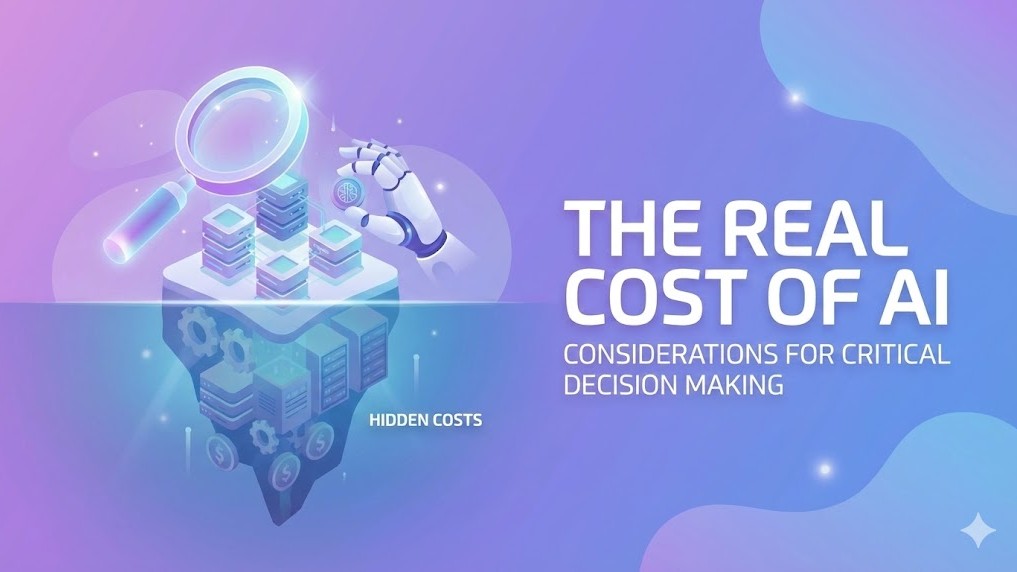
THE REAL COST OF AI
# Leadership
Considerations for Critical Decision Making

Rashid Smith

AI-Native Framework Team
Your team presents an AI pilot with a manageable $50,000 price tag. Then the production estimate arrives: $2.4 million. This pattern appears across boardrooms with surprising frequency. A 2025 study by Mavvrik found that only 15% of enterprises forecast their AI costs within a 10% margin. Nearly one in four miss by more than 50%.
AI doesn't get expensive because of model fees or token costs only. It gets expensive because scaling anything from an "interesting pilot" to "real business impact" demands the same foundation work as any other major initiative. Data readiness, platform stability, organizational change, and governance. That's where the real money tends to go.
An analysis from PYMNTS supports this. For every dollar spent on AI models, businesses spend five to ten dollars making them production-ready and enterprise-compliant. Integration work and change management often cost more than the models themselves.
Consider these three questions and a readiness framework to inform your decision on whether an AI investment is ready to move forward.
Understanding the Real Cost Curve
Budget shocks tend to come from the leap between a pilot and a scaled deployment. Pilots are cheap by design. They run on rented models, narrow datasets, and a small group of users. Scaling exposes everything fragile about your data, architecture, and operating model.
One useful frame: view AI Total Cost of Ownership across five layers. The exact numbers vary by industry and maturity level. Treat the ranges below as directional guides, not fixed formulas.
The Five Layers That Drive AI Cost
Cost Layer | % of TCO | Key Drivers |
Compute Consumption | 15–30% | · Tokens unit cost · Total inference cost · GPU compute hours · Model API fees
The line item that gets attention, though often not the largest over time. |
Platform & Infrastructure | 25–40% | · Security · MLOps & LLMOps · Guardrails · observability · Integration
This layer tends to become the biggest cost driver as workloads grow. |
Data Foundation | 15–25% | · Data cleaning · Integration · Quality · Governance Strong governance appears to cut implementation costs by 20–35%. |
People & Change | 20–30% | · Training · Process redesign · Communications
Often the reason pilots that "worked" struggle at scale. |
Opportunity Cost | Unquantified | What you delay or deprioritize to fund this initiative. |
What This Means: A $50,000 pilot turning into a multimillion-dollar rollout isn't automatically a failure. It can signal that AI is moving from a "tool experiment" to a "core business capability." The better question isn't "Why is it more expensive?" It's "Is the value at scale worth the build, and do we have the foundations to support it?"
Leadership's Three Questions
These questions can help determine whether an AI investment is ready for approval.
1. What's the Real Payback Period?
When scaling an AI solution, the question that matters is whether value arrives fast enough to justify the investment.
Deloitte's 2025 survey of 1,854 executives points to a pattern worth considering. Traditional technology projects often pay back within 7–12 months. But their data suggests organizations reach satisfactory ROI on a typical AI use case in two to four years. Only 6% reported returns within the first 12 months.
When reviewing an AI proposal, consider asking the team to show two curves.
• A cost curve from pilot to full rollout, including all five layers of TCO
• A value curve that converts impact into tangible outcomes like cost savings, productivity gains, revenue, or margin improvement
If the team can't show a credible payback window, even one that lands several years out, that's a signal they may not be ready to scale.
Scoping initiatives to demonstrate measurable value within 90 days tends to be an effective way to identify which AI projects drive the most learning and ROI. Not every initiative can achieve full ROI in that window, but the earlier value can manifest while building internal capabilities, the more risk gets reduced across the initiative overall.
2. Should We Buy, Build, or Partner?
This question deserves more nuance than a simple matrix can provide. The grid below is a starting point, but the real decision involves thinking about where you want to be in two to five years, not just what's fastest today.
Consider using this matrix as a thinking tool to guide your decision, not as a definitive answer.
| Low Strategic Differentiation | High Strategic Differentiation |
Low Technical Complexity | BUY IT. License or subscribe. Don't allocate talent to commodities. | BUILD LIGHTLY. Use vendor platforms, tailor the experience to your business. |
High Technical Complexity | BUY OR CO-SOURCE. Avoid heavy custom work for non-core functions. | PARTNER OR CO-DEVELOP. Competitive advantage likely lives here. Invest deeply. |
The Hidden Trade-off: Speed Today vs. Capability Tomorrow
Buying gets you speed. You can move quickly, avoid technical risk, and let someone else handle the complexity. That matters when proving value or responding to competitive pressure.
But there's a trade-off worth considering. When you buy, you don't develop internal capabilities. Your team doesn't learn how these systems actually work. You don't build the muscle memory that comes from struggling through integration challenges, data problems, and edge cases. If AI becomes central to how your business operates, that missing capability can become a liability.
Partnering sits in an interesting middle ground. A good partner relationship can provide learnings you'd never get from a vendor. You're closer to the work. Your team sees what's actually involved. You build institutional knowledge even without doing all the heavy lifting. That knowledge compounds over time.
There's also a cost accumulation problem with buying. Five AI use cases today might be twenty in three years. Each one comes with its own vendor, its own licensing fees, its own integration overhead. Organizations that build foundational technical capabilities, even if it's slower at first, often find they can move faster later. The teams know the stack. The patterns are established. The second and third use cases don't start from zero.
This isn't an argument for building everything. That's rarely the right answer. But any recommendation that's purely about speed-to-market deserves scrutiny if it ignores what capabilities you're developing along the way. The question isn't just "How fast can we get this done?" It's "What do we want to be good at in five years, and does this decision move us toward that?"
A useful question to ask the team: "What capabilities are we developing or giving up with this choice? And how does that affect our options two years from now?"
3. What Breaks When We Scale?
Every AI pilot has multiple hidden failure points. Data quality, security, user adoption, or process fit. Something tends to break. For a deeper look at identifying and addressing these failure points, see our AI-Native Change Agent Course.
A question worth asking: "Which assumptions from the pilot no longer hold true at 10,000 users?"
Expect a clear, specific answer. According to Mavvrik's research, a majority of companies miss AI forecasts by 11–25%, and nearly one in four are off by more than 50%. That gap doesn't come from bad arithmetic. It tends to come from untested assumptions about scaling.
Consider requiring the team to bring three things.
• A concise list of scaling risks across data, platform, security, operations, and adoption
• An estimate of the potential cost or downside for each risk
• A concrete plan for how those risks will be mitigated, tested, and funded
If this list doesn't exist, the rollout budget may be more of a guess than a plan.
The Readiness Test
Before approving a major AI investment, it's worth having the team score organizational readiness. Analysis from Deloitte's 2025 AI Readiness Index suggests that organizations with high readiness scores are about three times more likely to implement AI successfully within twelve months. Here's a simplified framework for assessing where you stand.
A Practical AI Readiness Score
Score each area from 0 to 5.
1. Data Quality & Accessibility. Is the data clean enough, integrated enough, and accessible enough for AI in production?
2. Clear, Measurable Use Case. Is there a specific business problem with a defined owner and quantifiable success metric?
3. Platform & Security Maturity. Is the infrastructure secure, scalable, and ready for AI workloads?
4. Organizational Capacity for Change. Is there culture, leadership support, and enablement capacity to change how people work?
5. Team Capability & Ownership. Is there a cross-functional team with clear accountability for delivering outcomes?
Scoring Guide
18–25 | GREEN LIGHT. Likely ready to proceed with targeted risk management. |
12–17 | PROCEED WITH CAUTION. Address gaps before large-scale rollout. Use phased funding. |
Below 12 | PAUSE. Build foundational capabilities first. Fund small experiments only. |
This isn't a diagnostic. It's a structured way to surface where the gaps are and have an honest conversation about them.
Making the Decision
AI initiatives tend to fail not because of the technology, but because leaders don't see the real cost curve until it's too late.
The role of leadership isn't to understand every model architecture. It's to ensure the organization is asking the right economic questions.
• Is the full cost clear, not just the pilot?
• Is there clarity on when and how the value shows up?
• Is this building a repeatable capability, not just a showcase?
When leadership understands how AI economics work, three things tend to follow. The right investments get approved faster because the case is clear. The wrong ones get avoided because the gaps become obvious. And the organization builds capabilities that outlast the current hype cycle and tie directly to margin, growth, and resilience.
The data, frameworks, and questions in this document are meant to support that decision. The decision itself belongs to you.
----------------------------------------------------------------------------
References
[1] McKinsey & Company. (2025, November). The State of AI in 2025: Agents, innovation, and transformation.
[2] Deloitte. (2025, October). AI ROI: The paradox of rising investment and elusive returns. Survey of 1,854 executives.
[3] PYMNTS. (2025, August 15). Enterprises Confront the Real Price Tag of AI Deployment.
[4] Hypestudio. (2025, March). Custom AI Solutions Cost Guide 2025: Pricing Insights Revealed.
[5] CFO Dive / Mavvrik. (2025, September 16). Most firms miss AI cost forecasts, survey finds.
[6] Creative Bits. (2025, October 22). AI Readiness Score. Based on Deloitte's 2025 AI Readiness Index.
[7] Mavvrik & Benchmarkit. (2025). 2025 State of AI Cost Governance. Research report.
3
Comments (3)
Popular

Dive in
Related
Blog
Beyond the Prompts and Tools: Why Most AI Training Isn't Enough
By Jason Flynn • Oct 29th, 2025 • Views 356
Blog
The New Essential Role in Every Enterprise: The AI-Native Change Agent
By Arun Saraswat • Nov 5th, 2025 • Views 72
Blog
The New Essential Role in Every Enterprise: The AI-Native Change Agent
By Arun Saraswat • Nov 5th, 2025 • Views 72
Blog
Beyond the Prompts and Tools: Why Most AI Training Isn't Enough
By Jason Flynn • Oct 29th, 2025 • Views 356